Welcome to Guangzhou Tongsen Electronic Technology Co., LTD. Website!


About SMT surface mount process detection technology
The miniaturization of electronic products inevitably leads to the continued miniaturization of SMT components. The pitch is now developing towards 0.1mm or even smaller sizes, wiring is becoming increasingly dense, and the use of BGA/CSP/FC is also increasing, making SMA components more and more complex.
The miniaturization of electronic products inevitably leads to the continued miniaturization of SMT components. Pin pitches are now developing towards 0.1mm or even smaller sizes, wiring is becoming increasingly dense, and the use of BGA/CSP/FC is also increasing, as well as the complexity of SMA components. All this places extremely high demands on the quality inspection technology of SMT products. This chapter introduces several main detection methods for SMT products, the working principles and detection technologies of related detection equipment, and the corresponding improved methods after lead-free conversion. SMT technology is a type of modern electronic assembly technology. The detection technologies used mainly include manual visual inspection (MVI), automatic visual inspection (AVI), automatic optical inspection (AOI), in-circuit testing (ICT), automatic X-ray inspection (AXI), functional testing (FT), and flying probe testing (FP).
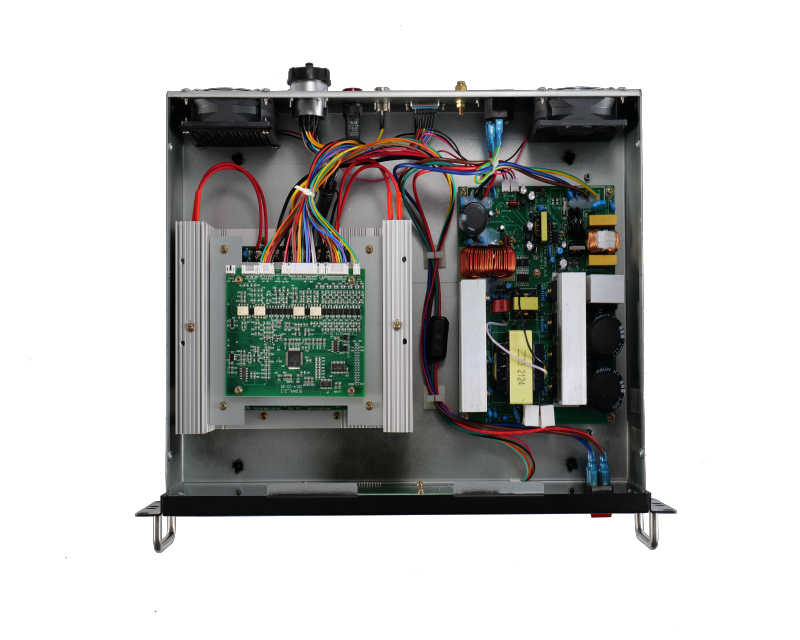
SAKI AOI appearance. Compared with other detection technologies, AOI can be used at multiple locations on the production line. Currently, AOI is mainly used in three inspection processes: 1) To minimize soldering defects caused by poor solder paste printing, 100% 2D and 3D detection methods are often used to detect the position and thickness of solder paste deposition. 2) Post-placement inspection to check for defects caused by solder paste printing and placement. 3) Post-reflow soldering inspection, mainly to check for soldering defects.
There are various applications of AOI technology in SMT, but the basic principle is the same: obtaining images of the object under test through optical means. Generally, the light image of the object to be detected is obtained through a sensor (camera) and digitally processed. This method of comparison, analysis, inspection, and judgment is equivalent to automated and intelligent manual visual inspection.
The AOI system is a precision device involving multiple disciplines. According to technology, the AOI system can be divided into four major parts: precision machinery, electrical control, image processing (CCD camera or vision system) system, and software system. The main modules can also be divided according to functions as needed.
1. Control System The AOI control system mainly completes the following functions: m-level precision motion control of the x and y precision worktables, motion control in the z-axis direction (CCD camera system), image acquisition, automatic positioning of the PCB board, and automatic control of the vacuum solenoid valve. The AOI control system consists of a host computer, motion control card, image card, and I/O interface board, etc., realizing three-coordinate and peripheral I/O interface control, ensuring precise and fast response of the movement, and cooperating with the mechanical and visual modules to realize the functions of the whole machine. The host computer is the core of the entire control system, realizing data acquisition, transmission, and analysis processing of the whole machine, and issuing instructions to various parts to complete mechanical transmission, image processing, and detection functions. The motion control card mainly realizes the acquisition of three-coordinate motion control signals, transmission of various processing data, and execution of action instructions. The image card mainly completes the image acquisition and conversion of the PCB board.
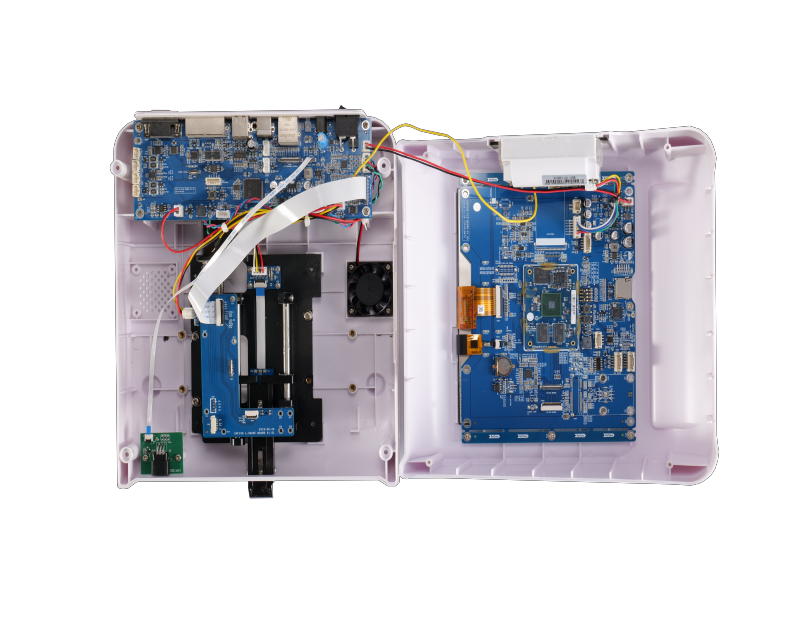
2. CCD Camera System Module The CCD camera system mainly consists of a camera, image card, and LED programmable light source. An LED is a solid-state semiconductor device, also known as a light-emitting diode, which can directly convert electricity into light. The video image signal acquired by the camera is transmitted to the frame acquisition card, and the image acquisition card controls the acquisition of the image. After the host computer processes the acquired video image, it returns the result to the main control program. The image can be observed in real time through the monitor, and other corresponding control processes can be completed. In the AOI CCD camera system, the optical illumination is completed by the LED light source, whose main function is to control the on/off, brightness, and direction of the light source. Through the human-machine interface control system, the CCD camera system can complete functions such as real-time image acquisition, closing acquisition, reading images, and displaying images. When the human-machine interface system issues a work command, the CCD camera system performs automatic scanning. The camera system can effectively identify PCB boards in various states.
3. Precision Mechanical System Module Each time a PCB board is inspected, the worktable of the AOI system must automatically move to the camera position for image acquisition. Even if the relevant data of these actions have been set in the program, if the machine parameters change due to changes in the precision of mechanical movement, etc., the correct inspection process cannot be completed. In order to achieve precise operation of the precision worktable, a precision ball screw and rolling linear guide driven by an AC servo motor are used to achieve closed-loop control of the position.
RECOMMENDED NEWS
High-end Custom Services: SMT Chip Processing Meets Diverse Industry Needs



(Telephone contact)
Email:
Address: Room 502, Building 1, No. 13, Bohua 4th Road, Huangpu District, Guangzhou City
COPYRIGHT © 2025 Guangzhou Tongsen Electronic Technology Co., Ltd. All rights reserved.