Welcome to Guangzhou Tongsen Electronic Technology Co., LTD. Website!


A step-by-step explanation of the printed circuit board (PCB) manufacturing process
Then, the final surface treatment is applied to the panel. This surface treatment (tin/lead solder or immersion silver, gold plating) protects the copper (solderable surface) from oxidation and serves as the location for soldering electronic components to the PCB.
PCB Board Manufacturing Steps
1. PCB Film Generation
Films for all copper and solder mask layers are made from exposed polyester film. We generate these films based on your design files, creating a (1:1) film representation that exactly matches your design. When submitting Gerber files, each individual Gerber file represents a layer of the PCB board.
2. PCB Raw Material Selection
Industry standard 1.6 mm thick FR-4 laminate, double-sided copper clad. Panel size accommodates multiple circuit boards.
3. PCB Drilling
Using a CNC drill and carbide drill bits, the through-holes required for your PCB design are created according to the files you submitted.
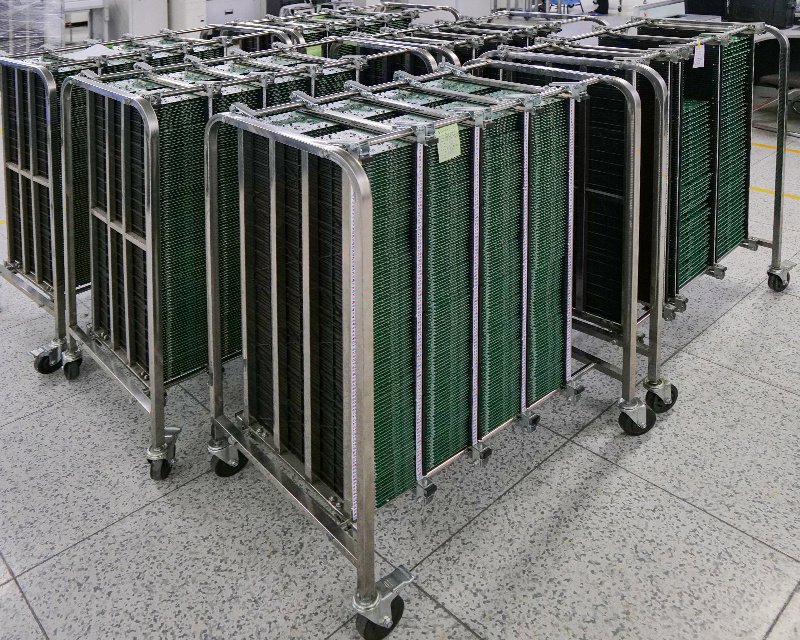
4. PCB Chemical Copper Plating
To electrically connect the through-holes to the different layers of the PCB, a thin layer of copper is chemically deposited in the through-holes. This copper will then be thickened by electroplating (step 6).
5. PCB Photoresist Coating and Imaging
To transfer the PCB design from electronic CAD data to the physical board, we first coat the panel with photosensitive photoresist, covering the entire circuit board area. Then the copper layer film image is placed on the circuit board, and a high-intensity UV light source exposes the uncovered portions of the photoresist. We then chemically develop the circuit board (removing the unexposed photoresist from the panel), forming the pads and traces.
6. PCB Plating
This step is an electrochemical process that increases the thickness of the copper in the holes and on the surface of the PCB. Once the copper thickness is increased in the circuits and holes, we plate an additional layer of tin on the exposed surface. This tin will protect the plated copper during the etching process (step 7) and will be removed afterward.
7. PCB Stripping and PCB Etching
This process is divided into several steps. First, the photoresist is chemically removed (stripped) from the panel. Then, the newly exposed copper is chemically removed (etched) from the panel. The tin applied in step 6 protects the desired copper circuits from being etched. At this point, the basic circuitry of the PCB is defined. The tin protective layer is chemically removed (stripped) to reveal the copper circuits.
8. PCB Solder Mask
Next, we cover the entire panel with a liquid solder mask. Using film and high-intensity UV light (similar to step 5), the solderable areas of the PCB are exposed. The main function of the solder mask is to protect most of the copper circuits from oxidation, damage, and corrosion, and to keep the circuits isolated during assembly.
9. PCB Legend (Silkscreen Printing)
Next, we print the reference designations, logos, and other information contained in the electronic file onto the panel. This process is very similar to an inkjet printing process, but specifically designed for PCB designs.

10. PCB Surface Finishing
Then the final surface finish is applied to the panel. This surface finish (tin/lead solder or immersion silver, gold plating) is used to protect the copper (solderable surface) from oxidation and serves as the place to solder electronic components to the PCB.
11. PCB Manufacturing
But not unimportant, we use CNC equipment to route the perimeter of the PCB from the larger panel. The PCB board is now complete and will be shipped to you promptly.
This is the manufacturing process for single-sided and double-sided PCB boards; the manufacturing of multilayer PCB boards is more complex. Lamination is required.
RECOMMENDED NEWS
High-end Custom Services: SMT Chip Processing Meets Diverse Industry Needs



(Telephone contact)
Email:
Address: Room 502, Building 1, No. 13, Bohua 4th Road, Huangpu District, Guangzhou City
COPYRIGHT © 2025 Guangzhou Tongsen Electronic Technology Co., Ltd. All rights reserved.