Welcome to Guangzhou Tongsen Electronic Technology Co., LTD. Website!


Why is solder paste an important factor in SMT?
Since the 1970s, surface mount technology has developed rapidly. As a result, it has become an important part of the global electronics market. As electronic products and their components become smaller, surface mounting will eventually replace through-hole mounting. In addition, surface mount technology ensures that printed circuit boards can accommodate many components without affecting performance.
Almost all modern electrical devices use printed circuit boards. Electronic components mounted on printed circuit boards are its key components. Surface mount and through-hole mounting are two methods of mounting components to printed circuit boards. In this article, we define surface mount technology as a process that is fully automated in most cases.
Since the 1970s, surface mount technology has developed by leaps and bounds. As a result, it has become an important part of the global electronics market. As electronic products and their components shrink, surface mount will eventually replace through-hole mounting. In addition, surface mount technology ensures that the printed circuit board can accommodate many components without affecting performance.
Advantages of Surface Mount Technology
Advantages
Miniature components
Greater component density (number of components in a given area) and more connections between each component. Reduced manufacturing start-up time and cost. Therefore, fewer holes are required.
Automation makes assembly easier and faster
When components are placed incorrectly on the soldering iron, the surface tension of the molten solder will pull them into correct alignment with the pads.
Both sides of the circuit board are used to place components
Reducing connection resistance and inductance improves high-frequency performance and reduces the likelihood of interference.
Excellent mechanical performance when shaken and trembled
SMT components are typically less expensive than through-hole components.
When should surface mount technology be used?
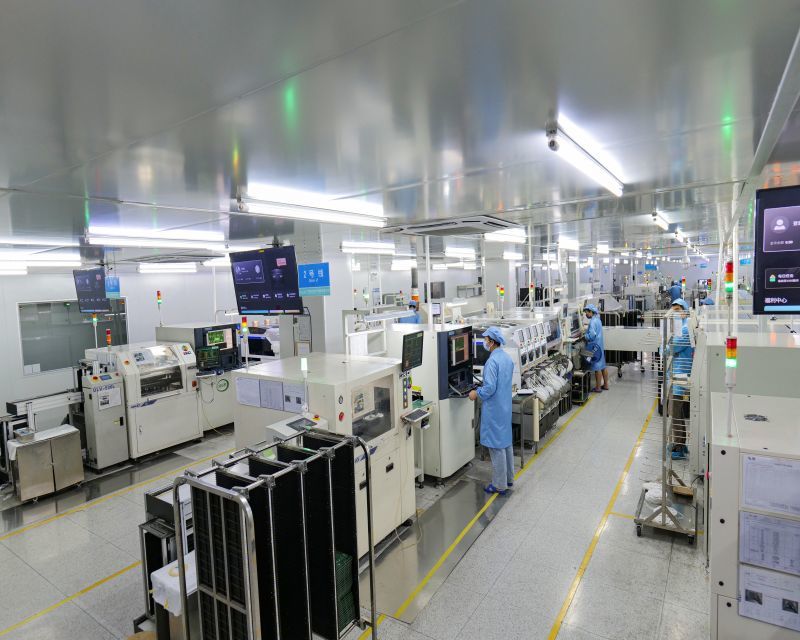
SMT is now widely used in every production and assembly step of PCBs. This is because it allows more electronic devices to be housed in a given volume. As a result, parts are more compact, and some parts perform better than their predecessors. They also work well with automated machines, so no manual operation is required during assembly.
When using wired components, automatic placement is never a foolproof option. All cables must be custom-made to meet the precise distances between holes, and even then, sometimes they don't stay there. In standard PCB construction, all components are automatically positioned. Manual intervention is rarely required. When using high-quality circuit boards, the need to modify the design to precisely fit the components is greatly reduced.
Applications of Surface Mount Technology
Household electronics.
Telecommunication services
Medical devices.
Regulatory methods in manufacturing.
Aerospace and military hardware.
Difficulties and Solutions that SMT Patching May Encounter
Problems
● Transmission reliability
● Printed circuit board modification
● Verification
● Supervision
Solutions
● Alternatives to oxidation paste
● Solder balls
● Fast transportation
● Insufficient openness

Factors to Consider When Choosing an SMT Manufacturer
1. Standards of materials used
In SMT production, the materials used are the primary consideration, and the operation of the materials directly affects the quality of reflow soldering.
2. Pad arrangement of the PCB
The PCB design must be precise to ensure that the SMT method works properly.
3. Stencil construction and layout
Applying solder paste to a printed circuit board (PCB) is a design masterpiece. However, the accuracy of the stencil structure directly affects the quality of the printed solder paste.
4. Pre-printing conditions
Standard printing processes rely on blade speed, pressure, cleaning procedures, and frequency.
5. Utilization of equipment and devices
High-density printing requires meticulous and repetitive labor due to the fewer modules per board, affecting the stability of the solder paste.
6. Links between components
Details determine success or failure, as the correct use of components requires careful component selection, correct connection, and pressure application.
7. Performing reflow soldering
Surface mount technology will be improved if reflow soldering can reliably deliver good results. To achieve this, the connections on the circuit board must have a high quality.
Previous
RECOMMENDED NEWS

High-end Custom Services: SMT Chip Processing Meets Diverse Industry Needs



(Telephone contact)
Email:
Address: Room 502, Building 1, No. 13, Bohua 4th Road, Huangpu District, Guangzhou City
COPYRIGHT © 2025 Guangzhou Tongsen Electronic Technology Co., Ltd. All rights reserved.